
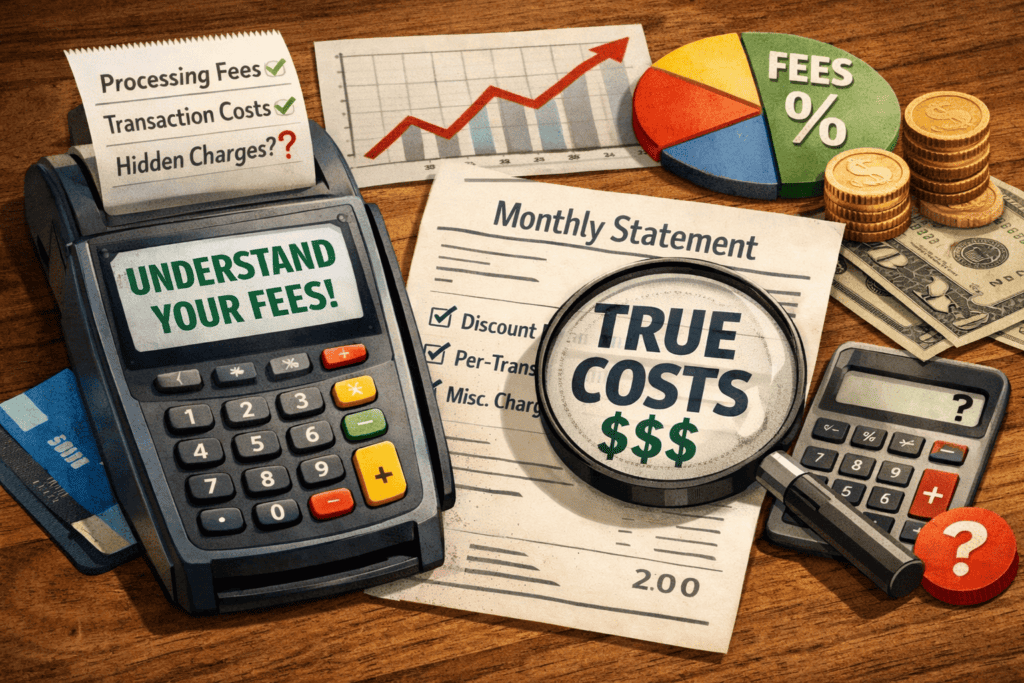
Five lessons that turn confusing fees into understandable numbers
If this week had a theme, it was this:
Credit card processing isn’t random — it’s just explained like someone got paid per confusing word.
Most business owners aren’t “bad at numbers.” They’re dealing with a system that’s layered, fragmented, and presented in a way that feels like it was designed to make you give up and go back to running your business.
So this week, we did the opposite of that.
We broke it down in plain English — and here’s the recap.
1) Why Your Credit Card Fees Feel Random (But Aren’t)
If you’ve ever opened your merchant statement and thought, “There’s no way these numbers are real,” you’re not alone.
The key idea: your fees usually fall into three buckets, even if your statement tries to disguise that fact with 47 line items and a vocabulary test.
- Interchange (what the customer’s bank gets)
- Card brand/network fees (Visa/Mastercard, etc.)
- Processor markup (the part your processor controls)
So when fees seem like they “change day to day,” it’s usually not because someone is making stuff up — it’s because your transaction mix changed (card type, keyed vs. tap, online vs. in-person, etc.).
Takeaway: It’s not random pricing. It’s bad translation.
2) What Actually Happens Between the Swipe and Your Bank Account
A card payment doesn’t teleport into your account.
It takes a trip.
Customer taps → terminal sends it → processor routes it → card network directs it → customer’s bank approves → you close your batch → funds settle → deposit hits (minus fees).
Each step has a job. Each job has a cost.
This is why two $50 sales can look identical at the register… and cost very different amounts behind the scenes.
- Debit with PIN? Usually cheaper.
- Premium rewards credit card? Usually more expensive.
- Online/keyed transactions? Higher risk, higher cost.
Takeaway: Once you understand the flow, fees stop feeling emotional and start feeling mechanical.
3) The Number That Actually Matters: Your Effective Rate
Processors love quoting one clean number.
“2.6%!”
“2.9% flat!”
And then your statement shows up like, “Surprise.”
That’s because quoted rate ≠ effective rate.
Your effective rate is the real cost you paid:
Total processing fees ÷ total card sales
It includes everything that actually left your account:
- per-transaction fees
- monthly/service/PCI/platform fees
- network/assessment fees
- chargeback/retrieval fees
- card-type differences (rewards/corporate/etc.)
None of those fees are “fake.”
They’re just often not included in the headline quote.
Takeaway: Quoted rates are marketing. Effective rates are reality.
4) The Hidden Reality of Card Costs (And Why They Quietly Eat Profit)
Cash and card feel equal when you’re ringing someone up.
Economically? Not even close.
Cash is a direct exchange.
Card payments are a paid financial service.
When someone pays with a card, you’re paying for real things like:
- fraud protection
- instant authorization
- access to bank credit
- rewards programs customers love
And on thin margins, that “only a few percent” can add up fast.
Example from the week:
A $10 coffee might cost ~$0.30–$0.40 to accept via card. Multiply that by thousands of transactions and you’re talking real money — not in one dramatic hit, but in tiny pieces that quietly disappear.
Takeaway: The danger isn’t that fees exist. It’s that they become invisible.
5) How to Read a Merchant Statement Without Your Eyes Glazing Over
Most owners avoid statements because they’re dense and exhausting — not because they don’t care.
But once it clicks, the statement stops being a wall of numbers and becomes a map.
Most businesses move through the same stages:
- Avoidance (skim the total, move on)
- Assumption (“this must all be required”)
- Education (something spikes, curiosity kicks in)
- Identification (you start spotting what’s negotiable vs. not)
- Better questions (this is where leverage lives)
And the best way to review? Don’t read it like a novel.
Scan it like a detective:
- Did total fees change?
- Did volume stay similar?
- Any new line items?
- Any rate increases?
- Any “misc” fees that look… convenient?
Takeaway: The win isn’t just savings. It’s confidence.
The Big Theme of the Week
You don’t need to become a payments expert.
You just need the system explained in human language.
Because here’s what happens when things are confusing:
- people stop checking
- “around 3%” becomes the default assumption
- small fees creep in
- margins erode quietly
And here’s what happens when things are clear:
- you ask better questions
- you spot unnecessary markups
- you compare offers intelligently
- you make decisions calmly
Confusion creates passivity.
Clarity creates control.
That’s the whole point.