
Think Raising Prices Is Your Only Option? Think Again.
Let’s talk about something almost every business owner has wrestled with.
Costs go up. Processing fees creep higher. Supplies cost more. Payroll increases. And suddenly you’re staring at your margins thinking:
“Well… I guess we have to raise prices.”
It feels logical.
It also feels awful.
No one wants to be “the expensive place.”
No one wants customers whispering that you’re squeezing extra dollars out of them.
No one wants that awkward moment explaining why everything now costs more.
So what happens?
Most owners stall.
They absorb.
They tell themselves it’s temporary.
They hope margins magically fix themselves.
But here’s the quiet truth most people miss:
Pricing structure vs price increase are not the same thing.
And understanding that difference changes everything.
The Difference Most People Overlook
When people hear “adjust pricing,” they automatically think:
“We’re raising prices.”
But that’s not always what’s happening.
Here’s the breakdown.
What a Price Increase Really Means
A price increase says:
“Everything costs more now.”
It’s simple. It’s direct. It’s visible.
The sticker changes. The menu updates. The numbers go up.
There’s nothing wrong with this approach. Many businesses do it. Sometimes it’s necessary.
But it’s blunt.
And it can feel heavy — both for you and for your customers.
What a Pricing Structure Change Actually Means
Now let’s look at the other side of pricing structure vs price increase.
A pricing structure change says:
“We’re aligning how we charge with how we get charged.”
That’s a completely different conversation.
It’s not about making everything more expensive.
It’s about acknowledging that different payment methods cost different amounts to process.
It’s about transparency.
And transparency feels very different than a hike.
A Real-World Example
Let’s make this simple.
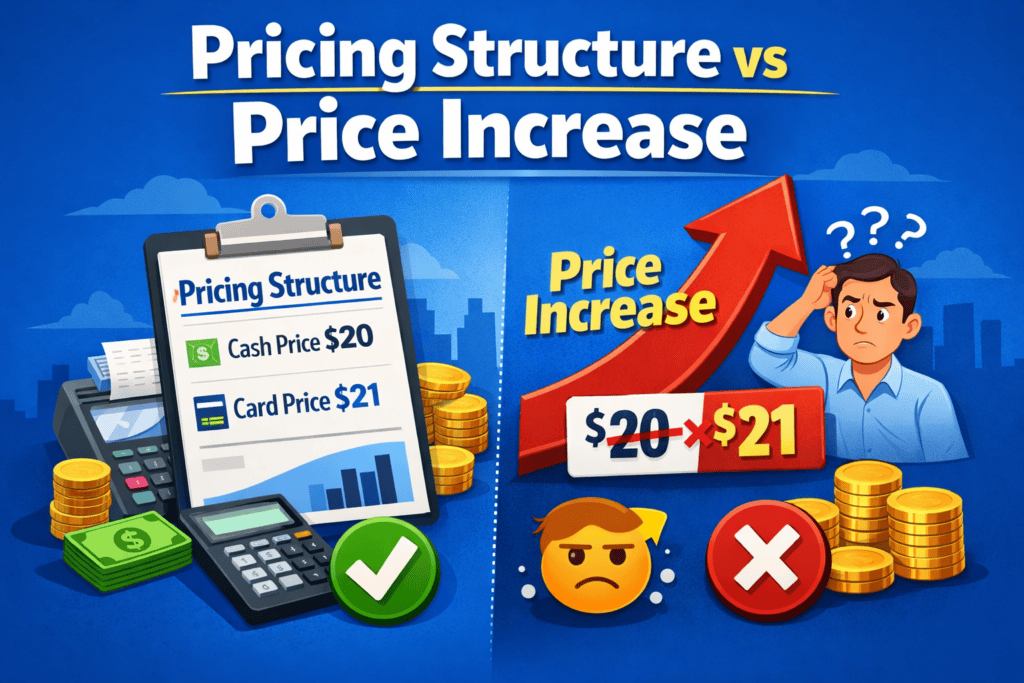
Two shops sell the exact same $20 item.
Shop A
They raise the price to $21 for everyone.
Cash? $21.
Card? $21.
Doesn’t matter.
Shop B
They keep the item at $20 but separate cash and card pricing.
Cash stays $20.
Card pricing reflects the processing cost.
Both businesses are responding to higher costs.
Only one changed the sticker price.
That’s the core difference in pricing structure vs price increase.
Why This Matters More Than Ever
Years ago, most businesses were built in what I call a “cash mindset.”
Cash was common. Card fees existed, but they weren’t dominating the conversation.
Fast forward to today.
Many businesses are now 80–95% card transactions.
Let that sink in.
Your cost structure changed dramatically.
But your pricing structure probably didn’t.
That gap?
That’s where margin pressure builds.
It sneaks in slowly. Quietly. Invisibly.
Until one day you realize you’re working harder for less.
This Isn’t About Pushing Costs onto Customers
And let’s clear something up.
This conversation isn’t about shifting every expense onto your customers.
It’s not about being sneaky.
It’s not about surprising people at checkout.
It’s not about nickel-and-diming.
It’s about reality.
If card usage exploded but pricing never evolved, something eventually breaks.
You have options:
- Absorb the fees.
- Raise prices across the board.
- Adjust your pricing structure.
- Explore compliant alternatives.
But the key word there is options.
Most owners were never told they had any.
Why So Many Owners Default to Price Increases
Here’s what I’ve noticed.
When people hear “costs are up,” the automatic response is:
“We need to raise prices.”
Why?
Because it feels simple.
It requires no explanation beyond, “Our costs increased.”
But simplicity doesn’t always mean strategy.
A price increase spreads costs evenly — even if the costs themselves aren’t evenly distributed.
That’s the heart of the pricing structure vs price increase conversation.
Card transactions cost money. Cash doesn’t.
So why do many businesses increase pricing across the board as if the cost applies equally to everyone?
Sometimes it’s habit.
Sometimes it’s lack of awareness.
Sometimes it’s fear.
The Emotional Side of Pricing
Let’s be honest.
Pricing isn’t just math.
It’s emotional.
Raising prices can feel like:
- You’re risking loyalty.
- You’re testing customer patience.
- You’re stepping into uncomfortable conversations.
That discomfort is real.
But here’s what’s interesting:
When pricing structure is framed around transparency, it often feels less confrontational.
You’re not saying, “Everything costs more.”
You’re saying, “Different payment methods have different costs.”
That’s logical.
That’s explainable.
That’s defensible.
Transparency Builds Trust
Customers today are smarter than ever.
They understand:
- Inflation exists.
- Card companies charge fees.
- Businesses have overhead.
When you explain the why — clearly and respectfully — most reasonable customers understand.
The problem isn’t usually the adjustment.
The problem is the surprise.
A blunt price increase can feel arbitrary.
A thoughtful pricing structure can feel transparent.
And transparency builds trust.
So Which One Is Right?
This isn’t a one-size-fits-all answer.
Some businesses absolutely choose to absorb the cost.
Some raise prices across the board.
Some adjust their pricing structure.
Some combine strategies.
The goal isn’t to tell you what to do.
The goal is to make sure you know the difference.
Because once you understand pricing structure vs price increase, you stop assuming there’s only one path.
And that alone is powerful.
Frequently Asked Questions
1. What is the difference between pricing structure vs price increase?
A price increase raises the cost of goods or services for everyone. A pricing structure change adjusts how charges are applied based on payment method or cost factors without necessarily raising the base price.
2. Is changing pricing structure the same as adding a surcharge?
Not always. A pricing structure can include dual pricing, tiered pricing, or other models. It depends on how it’s implemented and whether it complies with regulations.
3. Will customers get upset about pricing structure changes?
It depends on communication. Transparent, clear explanations usually reduce friction. Surprise fees without explanation create pushback.
4. Why don’t more business owners talk about pricing structure vs price increase?
Many were simply never educated on the distinction. Traditional advice focuses heavily on raising prices, not restructuring them.
5. Is raising prices bad?
No. Sometimes it’s necessary. The issue isn’t whether it’s good or bad — it’s whether it’s the only strategy being considered.
6. How do I know which approach is right for my business?
You need to look at your transaction mix, margin pressure, customer expectations, and compliance requirements. Often, reviewing real transaction data helps clarify the smartest path.
Final Thoughts
Here’s what I want you to walk away with:
When costs rise, raising prices is not the only move.
It’s one move.
But it’s not the only one.
The real conversation isn’t just about increasing numbers.
It’s about understanding pricing structure vs price increase and choosing the strategy that aligns with your reality, your margins, and your customers.
Because once you realize you have options, you stop reacting.
You start structuring.
And that’s a much stronger place to operate from.