
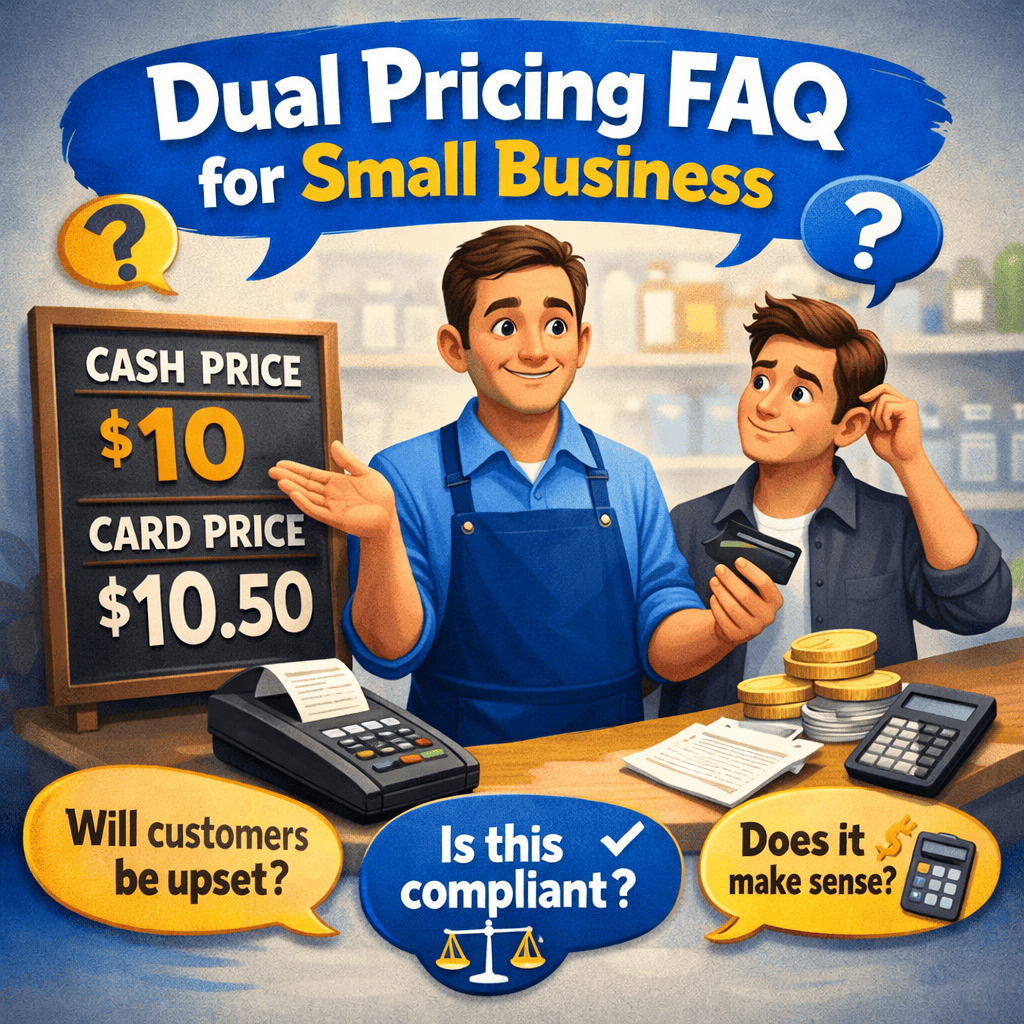
Let’s break down the biggest concerns small business owners have about dual pricing — calmly and honestly
If you’ve been hearing more about dual pricing lately, you’re not alone. A lot of small business owners are starting to explore it as a way to deal with rising credit card processing fees.
And naturally, once the topic comes up, the questions follow.
Some are practical.
Some are emotional.
And some are just based on misinformation.
So instead of turning this into a complicated finance discussion, I want to walk through the most common questions in a simple, honest way.
This dual pricing FAQ for small business owners is meant to clear the air and help you think about the decision logically — not emotionally.
Because at the end of the day, dual pricing isn’t a trend.
It’s a business decision based on math.
Let’s talk through the big concerns.
“Won’t Customers Get Mad?”
This is usually the first question.
And honestly, it’s a fair one.
No business owner wants to do anything that might upset their customers. Your reputation matters, and the last thing you want is friction at checkout.
But here’s the reality most businesses discover once they implement dual pricing:
Clear communication prevents most problems.
Customers typically get frustrated when they feel surprised or misled. When a fee suddenly appears at the register without explanation, that’s when complaints happen.
Dual pricing works differently.
When it’s done correctly, pricing is clearly communicated upfront. Customers can see that there are two prices:
- A cash price
- A card price
This transparency actually removes confusion instead of creating it.
Think about it this way.
Customers already understand that credit cards cost businesses money. They see it everywhere — gas stations, service companies, and even some retail shops.
When it’s explained clearly, most people simply choose the payment option they prefer and move on.
In practice, the majority of customers don’t complain.
They just make a choice.
“Is Dual Pricing Risky?”
Another common concern is whether dual pricing could cause legal or compliance problems.
The short answer:
Not when it’s structured correctly.
Dual pricing programs that follow proper guidelines are designed to comply with card network rules and disclosure requirements.
The key factor here is clarity.
Customers must understand what they are paying before they complete the transaction. That means things like:
- Clear signage
- Transparent pricing
- Receipts that match the displayed prices
- No hidden surprises
When these elements are handled properly, dual pricing becomes a straightforward pricing structure rather than something risky.
It’s similar to how businesses display sales tax or delivery fees.
The important thing isn’t avoiding the cost — it’s making sure the customer understands it ahead of time.
If you want to review the official card network guidance, you can also check resources from the Visa Merchant Rules which outline transparency requirements.
The bottom line?
Compliance isn’t complicated.
It’s about being clear and upfront.
“Is Dual Pricing Right for Every Business?”
Short answer:
No.
And that’s important to say out loud.
There’s no pricing strategy that works for every single business.
Dual pricing works well for many small businesses — especially ones that process a high volume of card payments — but it isn’t automatically the right move for everyone.
The decision usually comes down to a few factors:
Transaction Volume
Businesses with a higher number of transactions often see a larger financial impact from card processing fees.
Average Ticket Size
Even small percentage fees can add up quickly depending on your average sale amount.
Customer Behavior
Some customer bases are more card-heavy than others.
For example:
- Restaurants
- Service businesses
- Auto repair shops
- Convenience stores
These types of businesses often see significant card usage, which makes processing fees a noticeable expense.
Dual pricing simply gives the business owner a way to manage that expense differently.
But again — it’s not about copying what another business is doing.
It’s about looking at your own numbers.
That’s why I always say:
Dual pricing is a math decision, not a trend.
“Why Hasn’t My Processor Told Me About This?”
This question comes up more often than you might think.
Many business owners discover dual pricing through industry conversations, articles, or other merchants — not through their current payment processor.
And when that happens, the natural question is:
Why didn’t anyone mention this before?
The answer is usually pretty simple.
Sometimes it’s just easier to sell rates than it is to explain structure.
Traditional payment processing conversations tend to focus on things like:
- Lower percentages
- Discount rates
- Transaction fees
- Monthly statements
Those conversations are simple and familiar.
Dual pricing requires a different type of discussion — one that focuses on how pricing is presented to customers.
It’s not necessarily malicious or intentionally hidden.
It’s just that education takes more time than quoting a rate.
And in many cases, the payment industry hasn’t done the best job of explaining all the available options to small businesses.
That’s starting to change as more merchants begin asking questions and exploring alternatives.
What Dual Pricing Really Comes Down To
Once you remove the confusion and objections, dual pricing becomes a pretty straightforward concept.
A business offers two prices:
- One for cash
- One for card
Customers choose how they want to pay.
That’s it.
It doesn’t require complicated systems or uncomfortable conversations when it’s set up properly.
What matters most is transparency.
Customers should understand the pricing before they pay, and businesses should feel confident about how the program is structured.
When those two pieces are in place, dual pricing becomes simply another tool that business owners can evaluate — just like any other financial decision.
Final Thoughts
Small business owners deal with enough complexity already.
Rising costs, tight margins, and constant operational decisions make it important to understand every option available.
The goal of this dual pricing FAQ for small business owners isn’t to convince anyone to adopt the model.
It’s simply to bring clarity to the conversation.
Because once the noise and assumptions are removed, the topic becomes much simpler.
It’s not about trends.
It’s not about pressure.
It’s just about understanding your numbers and choosing what works best for your business.
And that’s always where good decisions start.