
The Hidden Price Tag Behind Every Tap, Dip, and Swipe
Let’s be honest for a moment.
Most small business owners feel that credit cards are expensive—but they don’t always stop to think why, or what those costs are really doing to their bottom line over time. You swipe, tap, or insert a card, the payment goes through, and you move on to the next customer. It feels simple. Almost invisible.
But behind that single beep of approval is a paid financial service—one that quietly takes a slice of every sale.
This article breaks that down in plain English. No jargon. No scare tactics. Just a clear, conversational look at why cash and card don’t cost the same, how those costs add up, and why pricing alignment matters more now than ever.
Why Cash and Card Aren’t Equal (Even Though We Treat Them Like They Are)
At first glance, money is money.
A $10 bill and a $10 card payment feel identical when they land in your register or bank account. But economically, they are very different.
Cash is simple.
Card payments are not.
Cash is a direct exchange. A customer hands you physical currency, and the transaction is done. There are no third parties approving the payment, no networks verifying identity, and no banks advancing funds on someone else’s behalf.
Card payments, on the other hand, are a financial service.
And like any service, they come with a price.
Cards Are a Paid Service — Not Free Infrastructure
One of the biggest misconceptions in business is that card payments are just “part of doing business,” like electricity or rent. But that framing hides what’s really happening.
When a customer pays with a card, several things occur instantly:
- The customer’s bank checks if funds or credit are available
- The card network validates the transaction
- Fraud detection systems analyze the payment in real time
- Funds are temporarily fronted to you before final settlement
- Reward points or cash back are earned by the customer
None of that is free.
Those systems exist to protect everyone involved—the customer, the bank, and yes, the business. But the cost of that protection and convenience usually lands on one party.
You.
What You’re Actually Paying For When You Accept Cards
It helps to be specific here. Card processing fees aren’t just some vague penalty for going cashless. They pay for real, tangible services.
1. Fraud Protection
Every card transaction is screened for suspicious behavior. This reduces your exposure to stolen cards, fake accounts, and chargebacks.
2. Instant Authorization
You know immediately whether a payment is approved. No waiting. No bounced checks. No “I’ll pay you later.”
3. Access to Bank Credit
Many customers are spending money they don’t actually have yet. The bank fronts that money to you, then collects from the customer later.
4. Consumer Rewards Programs
Points, miles, and cash back don’t come from thin air. They’re funded by interchange fees baked into card transactions.
So when customers say, “Why don’t you just raise prices?”—this is part of the answer. You’re already paying for benefits they enjoy.
Why This Matters More Than Most Owners Realize
On paper, card fees don’t look terrifying.
Two percent here. Three percent there.
But margins in small businesses are often thin to begin with. When you quietly lose a few percent on every sale, the long-term impact can be massive.
The danger isn’t the fee itself—it’s how invisible it becomes.
When costs are hidden inside pricing, they don’t trigger alarms. They just slowly eat away at profitability.
A Simple Example That Tells the Whole Story
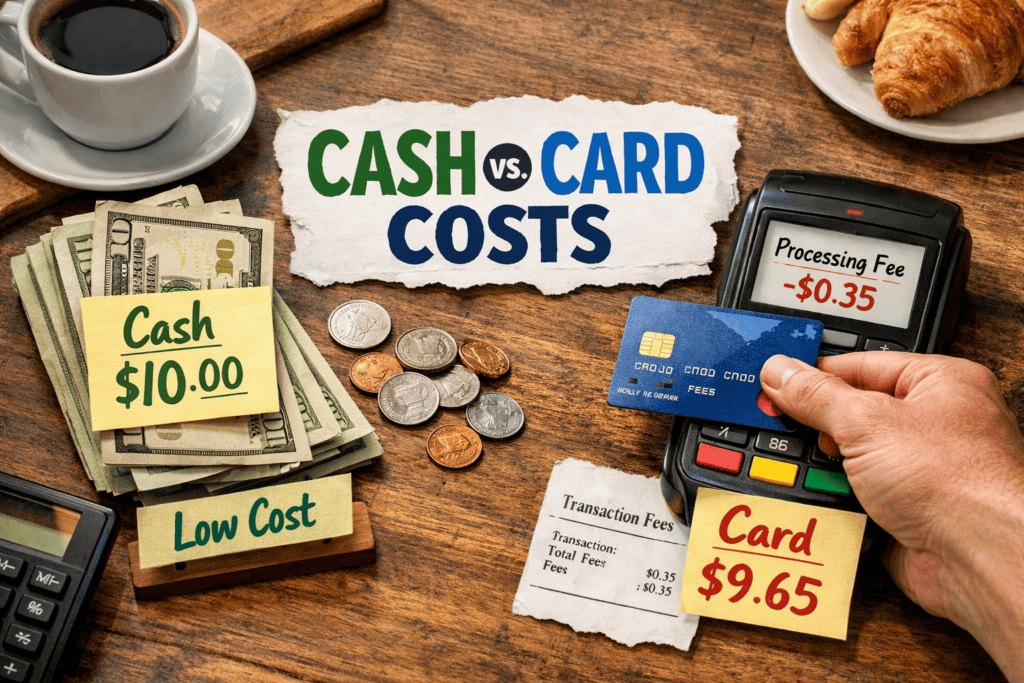
Let’s take something familiar: a $10 coffee.
Cash Sale
- Payment method: Cash
- Cost to accept: Close to $0
- Net to business: Almost the full $10
Card Sale
- Payment method: Credit card
- Cost to accept: Roughly $0.30–$0.40
- Net to business: $9.60–$9.70
Now zoom out.
If you sell:
- 100 coffees a day
- 6 days a week
- 50 weeks a year
That’s 30,000 transactions.
Multiply that $0.30–$0.40 across all of them, and suddenly you’re talking about thousands of dollars—not in one dramatic hit, but in tiny, forgettable pieces.
That’s why credit card processing costs for small business aren’t just an accounting detail. They’re a structural issue.
Why Most Businesses Just Absorb the Cost
If card payments are so expensive, why don’t more businesses do something about it?
Because changing pricing feels risky.
Card usage exploded faster than pricing models evolved. Customers got used to tapping cards everywhere, while businesses quietly adjusted margins to compensate—often without realizing they were doing it.
Over time, absorbing the cost became “normal.”
But normal doesn’t always mean sustainable.
The Psychological Trap of Treating Fees Like Rent
Rent is fixed. Utilities fluctuate, but they’re external. You can’t control them much.
Card processing fees feel similar, so they get lumped into overhead.
The problem?
Unlike rent, card fees scale with success.
The more you sell, the more you pay.
That means:
- Your busiest days are also your most expensive days
- Growth doesn’t always translate cleanly into profit
- High-volume, low-margin businesses feel the pain the most
This is why awareness matters before action.
Transparent Pricing Isn’t a Trick — It’s Alignment
There’s a growing conversation around transparency in pricing. Some people misunderstand this and assume it’s about sneaky fees or nickel-and-diming customers.
It’s not.
Transparency is about alignment.
When costs are visible, they can be managed, explained, and optimized. When they’re hidden, they quietly distort decisions.
Clear pricing structures:
- Reflect the true cost of doing business
- Protect margins without surprise losses
- Build trust when communicated honestly
Customers are often more understanding than businesses expect—especially when the reasoning is clear and respectful.
Why Customers Love Cards (Even If You Pay for Them)
It’s worth acknowledging the other side of the equation.
Customers prefer cards because they’re:
- Fast
- Convenient
- Secure
- Rewarding
From their perspective, cards feel “free.” That’s because they rarely see the cost directly.
This creates an imbalance: customers get convenience and perks, while businesses absorb the infrastructure costs that make it possible.
Understanding this dynamic doesn’t mean rejecting cards—it means pricing and planning with eyes wide open.
The Long-Term Risk of Ignoring Card Costs
Ignoring these fees doesn’t cause instant failure. That’s what makes them dangerous.
Instead, you might notice:
- Profits shrinking despite steady sales
- Higher volume not delivering higher income
- Price increases that still don’t “fix” margin issues
By the time the problem becomes obvious, it often feels unsolvable.
But awareness earlier changes everything.
What Smart Small Businesses Are Doing Differently
Forward-thinking businesses aren’t eliminating card payments. They’re simply designing around reality.
That might include:
- Reviewing pricing structures regularly
- Encouraging lower-cost payment methods where appropriate
- Educating staff so conversations with customers feel natural
- Choosing processors with transparent fee structures
- Switching to dual-pricing, cash discounting, and differential pricing
The goal isn’t to punish card users—it’s to stop pretending all payments cost the same.
FAQs: Credit Card Processing Costs for Small Business
1. Why do card payments cost more than cash?
Because card payments involve banks, networks, fraud protection, and credit systems. Cash is a direct exchange with almost no third-party involvement.
2. Are these fees negotiable?
Sometimes. Rates depend on volume, industry, and processor. It’s worth reviewing contracts regularly and comparing options.
3. Do customers mind when businesses explain card costs?
Surprisingly, many don’t—especially when explanations are calm, transparent, and respectful.
4. Are debit cards cheaper than credit cards?
Often, yes. Debit cards typically involve lower interchange fees, though costs still exist.
5. Can small businesses legally adjust pricing based on payment method?
Rules vary by region and card network. Always check local regulations and processor agreements.
6. Is it bad for customer experience to talk about payment costs?
Not if done thoughtfully. Clear communication builds trust more often than it harms relationships.
The Bigger Picture: Awareness Leads to Better Decisions
At the end of the day, this isn’t about blaming card companies or changing how customers want to pay.
It’s about understanding reality.
Once you see that card payments are a paid service—and not free infrastructure—you start making smarter decisions. You price more intentionally. You protect margins. You stop letting invisible costs dictate your future.
That’s the real lesson behind credit card processing costs for small business.
Final Thought
Cash and card don’t cost the same. They never have.
Treating them like they do doesn’t make the problem go away—it just hides it.
And in business, what’s hidden is usually what hurts the most.