
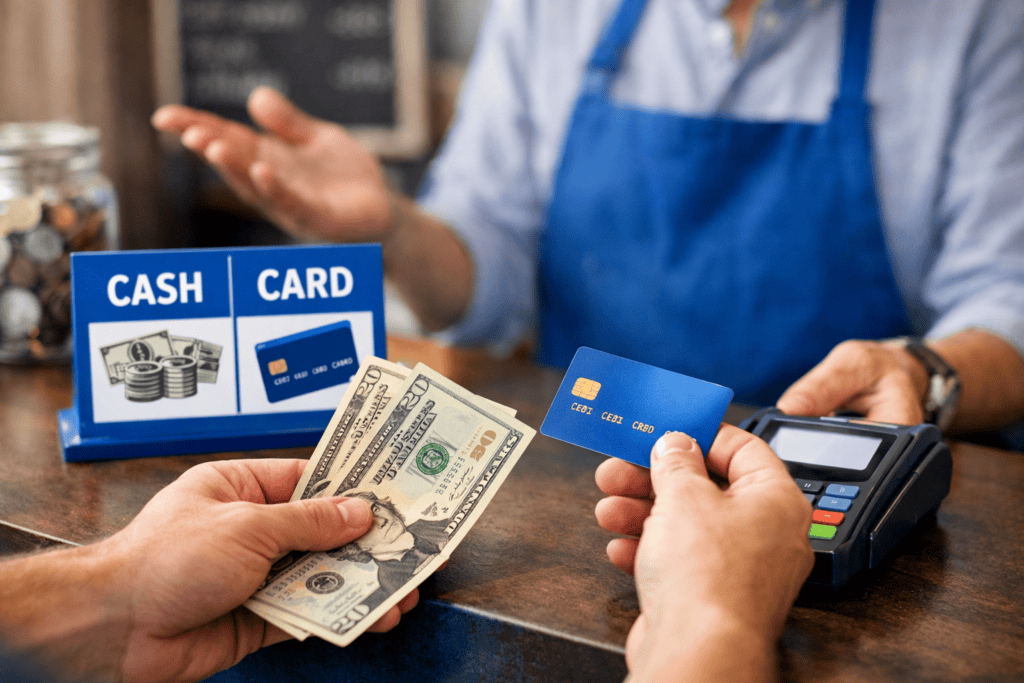
It’s Not About Cash or Card — It’s About Clarity
Let’s talk about something that keeps a lot of business owners up at night.
Payment options.
Specifically, the big question: do customers prefer cash or card pricing?
I hear this concern constantly.
“What if customers get upset?”
“What if they think I’m charging extra?”
“What if it hurts the customer experience?”
Fair concerns. Truly.
Nobody wants friction at checkout. That’s the last place you want tension. It’s supposed to be the easy part.
But here’s what I’ve seen over and over again.
The fear business owners carry around this topic is usually bigger than the reality.
The Myth: Customers Hate Payment Options
There’s this assumption floating around that customers dislike having multiple pricing structures.
That if you show a cash price and a card price, people will:
- Get confused
- Feel tricked
- Leave frustrated
- Or worse, never come back
But that’s not really what happens.
Customers don’t hate options.
They hate surprises.
And those two things are very different.
What Actually Upsets Customers
Let’s break this down simply.
Customers get frustrated when:
- Fees appear at the end
- Pricing feels hidden
- Something wasn’t explained clearly
- They feel like they’re being “gotcha’d”
It’s not about the card.
It’s not about the cash.
It’s about the moment they feel misled.
If someone expects to pay $100 and suddenly it’s $103.50 with no warning, that creates friction.
Not because of the $3.50.
But because of the surprise.
Everyday Example: Gas Stations
Let’s use an example we all understand.
Gas stations have displayed cash and credit pricing for years.
Two prices.
Side by side.
Big and bold.
And guess what?
Nobody panics.
Nobody storms inside demanding justice.
Nobody says, “This is unethical!”
Why?
Because it’s visible.
It’s normal.
It’s been communicated clearly for decades.
You pull up.
You see the prices.
You choose.
Simple.
That’s alignment.
So… Do Customers Prefer Cash or Card Pricing?
Here’s the honest answer.
Most customers don’t have a strong emotional preference.
What they prefer is:
- Predictability
- Transparency
- Control
If you give people a clear choice, they’re usually fine.
Some will pay with a card without thinking twice.
Some will use cash to save a little.
Some won’t even notice.
But very few react negatively when pricing is upfront.
The backlash business owners imagine?
It often lives more in their head than in real customer behavior.
Why Transparency Builds Trust
When you clearly communicate your pricing structure, something important happens.
You remove tension.
And tension is what people really respond to.
Clear signage.
Clear explanation.
Clear receipts.
That’s what builds trust.
If someone walks up to your counter and already understands their options, there’s no drama.
No awkward conversation.
No defensive explanation.
No apologies.
Just clarity.
And clarity feels fair.
The Real Psychology at Checkout
Here’s something most people don’t talk about.
At checkout, customers are already in decision mode.
They’ve chosen your product.
They’ve chosen your business.
They’re ready to complete the transaction.
That moment is fragile.
If you introduce confusion, you create doubt.
If you introduce clarity, you reinforce confidence.
When pricing is transparent, the brain relaxes.
When it’s unclear, the brain starts scanning for threat.
This has less to do with cash vs. card and more to do with perceived honesty.
People don’t mind paying.
They mind feeling manipulated.
What Customers Actually Value
Let’s simplify this even further.
Customers value:
- Predictability – Knowing what they’ll pay before they reach the counter.
- Transparency – Understanding why there’s a difference in pricing.
- Control – Being able to choose the option that works for them.
That’s it.
It’s not complicated.
When you provide those three things, friction drops dramatically.
The Fear Business Owners Carry
A lot of business owners imagine worst-case scenarios:
“What if someone yells at my staff?”
“What if social media complains?”
“What if it hurts reviews?”
And sure — if you implement pricing poorly, that can happen.
But that’s not a cash-or-card issue.
That’s a communication issue.
If signage is unclear…
If staff can’t explain it…
If it feels sneaky…
Then yes, people react.
But when it’s structured clearly and confidently, customers usually accept it without drama.
This Isn’t About Pressure
Let’s be clear.
Dual pricing should never feel like pressure.
It’s not about punishing card users.
It’s not about pushing cash aggressively.
It’s about alignment.
You’re aligning your pricing with your cost structure.
You’re giving customers a visible choice.
And when people feel included in the decision, they’re less likely to resist it.
That’s human nature.
Clear Communication Lowers Tension
Here’s a simple rule:
Confusion raises tension.
Clarity lowers it.
If you’re wondering whether customers prefer cash or card pricing, the better question might be:
Have I explained it clearly?
Because when it’s communicated well:
- Customers understand
- Staff feel confident
- Transactions move smoothly
- Trust increases
And trust is what keeps people coming back.
What Happens When You Hide It
Now let’s flip it.
What happens if pricing differences aren’t communicated clearly?
You get:
- “Wait, why is this more?”
- “Nobody told me that.”
- “That wasn’t on the menu.”
That’s when emotions spike.
Not because of the card fee itself.
But because expectations were broken.
Broken expectations feel unfair.
And fairness matters more than payment method.
Final Thoughts
So, do customers prefer cash or card pricing?
Most customers prefer clarity.
They prefer knowing their options.
They prefer feeling informed instead of surprised.
The fear around offering payment choices is often louder than the actual customer response.
When done right, it doesn’t create friction.
It creates transparency.
And transparency tends to feel fair.
That’s what builds trust.
Not the payment type.
The clarity around it.