
Busy feels successful — until you look at the math
On the surface, this coffee shop looked like a success story.
Line out the door most mornings.
Loyal regulars.
Five-star reviews.
The owner? Completely exhausted — which, let’s be honest, usually feels like proof the business is working.
And in a way, it was.
But when we dug into the numbers, the story shifted.
Not dramatically.
Not catastrophically.
Just quietly.
And sometimes that’s worse.
The Numbers That Changed Everything
Here’s what we saw:
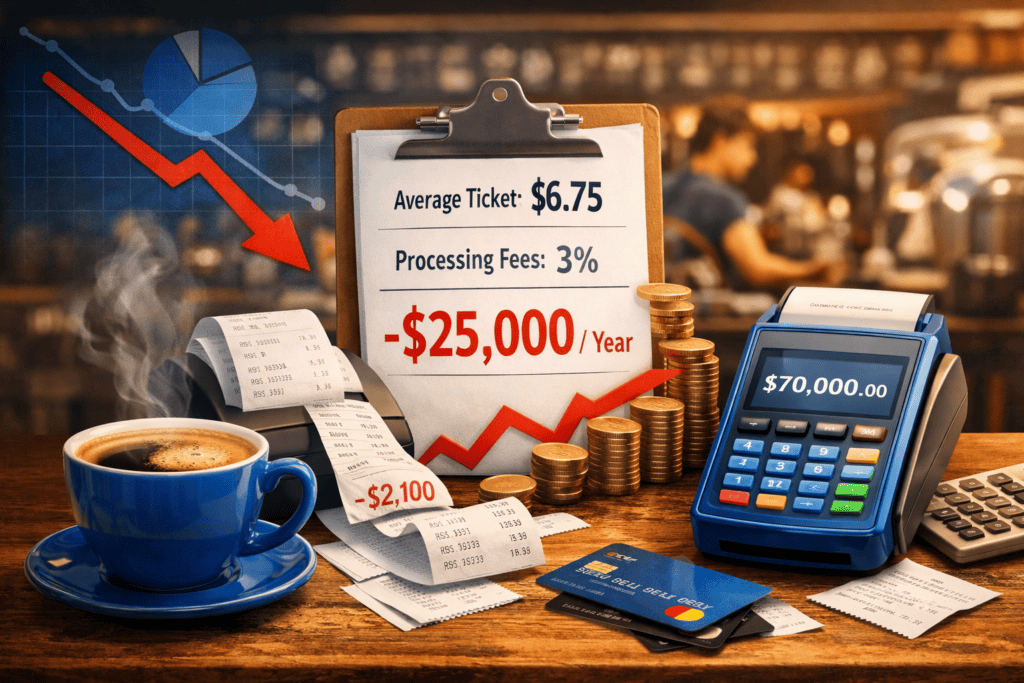
- Average ticket: $6.75
- 92% of transactions were card payments
- Effective processing rate: just over 3%
At first glance, 3% doesn’t feel like a crisis.
Three percent feels harmless. Manageable. Normal.
But let’s multiply it.
They were running about $70,000 per month in card sales.
At just over 3%, that’s roughly:
- $2,100 per month
- More than $25,000 per year
Now pause for a second.
For a massive franchise chain? Maybe that’s a line item.
For a single-location coffee shop?
That’s real money.
That’s payroll flexibility.
That’s equipment upgrades.
That’s breathing room.
And this is exactly why understanding credit card processing costs for coffee shops matters more than most owners realize.
Busy Doesn’t Automatically Mean Profitable
Here’s where it gets tricky.
Coffee shops are naturally high-volume, low-ticket businesses.
You’re selling:
- $4 lattes
- $3 drip coffee
- $6 breakfast sandwiches
Margins feel solid — until you layer in reality.
Let’s talk about what actually eats profit in a coffee shop:
- Labor
- Rent
- Utilities
- Supplies
- Waste
- Equipment maintenance
- Spoilage
- Cleaning
- Insurance
The list doesn’t stop.
So when 92% of your revenue is running through a card processor, those small percentage fees compound fast.
They weren’t losing money.
But they weren’t keeping what they thought they were keeping either.
And that’s the dangerous middle ground.
The Illusion of “It’s Only 3%”
Three percent feels small because we see it as a fraction.
But when almost all of your transactions are card-based — which is increasingly common — that 3% isn’t applied occasionally.
It’s applied constantly.
In this case:
- 92 out of every 100 transactions
- Every single day
- All year long
That’s not a side expense.
That’s structural.
And here’s the key distinction most owners miss:
There’s a difference between accepting cards and structuring card costs properly.
One is operational.
The other is strategic.
Why Coffee Shops Feel This More Than Most Businesses
Not every industry feels processing fees the same way.
A furniture store selling a $2,000 couch absorbs 3% differently than a café selling a $5 cappuccino.
In coffee shops:
- Ticket sizes are small
- Volume is high
- Margins are tight
- Card usage is dominant
That combination makes credit card processing costs for coffee shops uniquely impactful.
You don’t have pricing flexibility like luxury retail.
You can’t just tack on a dollar to every item without customers noticing.
So ignoring processing structure quietly compresses margin.
And compressed margins create stress.
What We Changed (Without Creating Drama)
Here’s the part I like.
We didn’t recommend:
- A dramatic price hike
- A risky loyalty overhaul
- A new POS system
- Cutting staff
Instead, we made a structural adjustment.
The goal wasn’t to “save money.”
It was to align card costs with card usage.
Subtle shift.
Clear math.
No emotion.
And here’s what didn’t happen:
- No customer backlash
- No angry reviews
- No awkward conversations at the register
Just improved margin clarity.
Sometimes the most powerful changes are the least visible.
Awareness Changes Outcomes
Most owners don’t ignore their numbers because they don’t care.
They ignore them because they’re busy.
Running shifts.
Training staff.
Managing inventory.
Handling vendor calls.
When a café is full, it feels like validation.
But revenue and retained profit are not the same thing.
The shift here wasn’t hype-driven.
It wasn’t emotional.
It wasn’t fear-based.
It was awareness.
When you see the actual annual impact of credit card processing costs for coffee shops, it reframes decisions.
Suddenly it’s not “just 3%.”
It’s $25,000.
And $25,000 deserves attention.
The Bigger Takeaway for Coffee Shop Owners
If you own a coffee shop, here’s the honest truth:
Card payments aren’t optional anymore.
They’re expected.
Customers tap, swipe, and move on.
But you still control structure.
You still control alignment.
You still control awareness.
And in a high-volume, low-ticket business, small structural inefficiencies compound faster than you think.
This isn’t about blaming processors.
It’s not about shaming owners.
It’s about clarity.
Because once you see the math, you can make intentional decisions.
Before that?
You’re just hoping the line out the door equals profit.
And sometimes it doesn’t.
Final Thought
This coffee shop wasn’t failing.
It wasn’t mismanaged.
It wasn’t careless.
It was busy.
And busy can hide a lot.
When we adjusted the structure around their credit card processing costs for coffee shops, nothing dramatic happened on the surface.
But underneath?
Margins breathed again.
Not because of emotion.
Not because of hype.
Just numbers.
And numbers don’t lie.